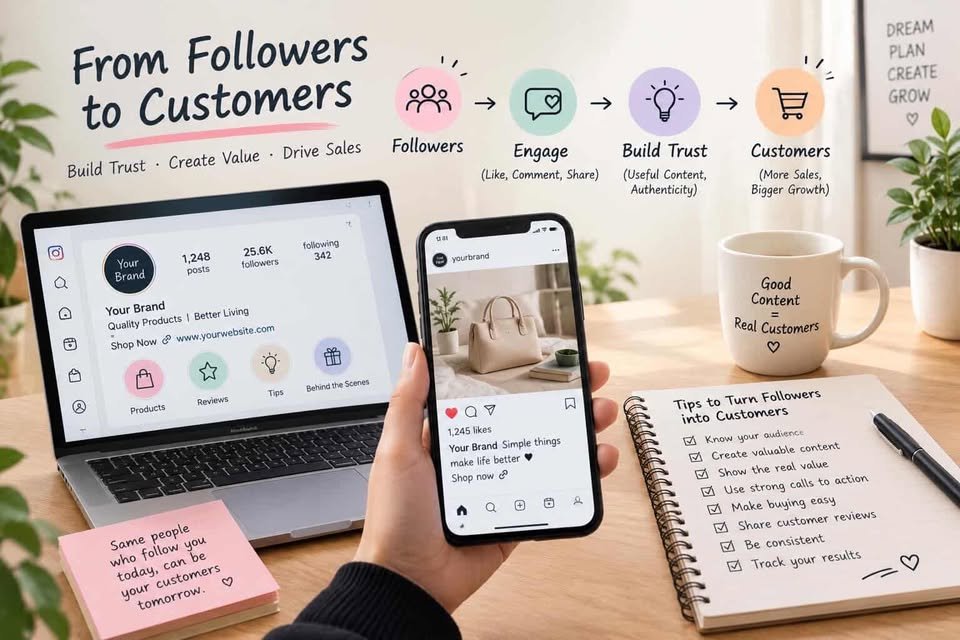
In today’s digital world, social media has become an important part of marketing. Businesses use platforms like Instagram, Facebook, LinkedIn, and other social networks to connect with people, share content, and promote their products or services.
Building a large following can feel like a big achievement. But there is an important question every business should ask:
How to Turn Followers into Customers ?
Having a large number of followers is a great achievement, but it does not always lead to business growth. What matters most is how you engage with your audience and build their trust. By sharing useful content, understanding their needs, and showing the value of your products or services, you can Turn Followers into Customers and create meaningful business results.
Social media is not just about gaining likes and followers. It is about building genuine relationships with people and guiding them toward the right action. A strong strategy can help you Turn Followers into Customers by creating trust, providing value, and making it easy for your audience to choose your brand.
What Is the Difference Between Followers and Customers?
A follower is someone who chooses to follow your social media account. They may be interested in your content, brand, products, or industry.
A customer is someone who actually purchases your product or service.
For example, imagine an Instagram page has 20,000 followers but only a few people purchase from the business.
Another page may have only 3,000 followers but regularly receives orders from its audience.
Which page is more valuable?
The second one may have a smaller audience, but its followers are more interested and more likely to become customers.
This is why quality of followers can be more important than quantity.
- Understand Your Audience
The first step toward turning followers into customers is understanding who they are.
You need to know what your audience wants, what problems they have, and what motivates them.
Ask questions such as:
- Who are my ideal customers?
- What problems are they facing?
- What do they need?
- What are they interested in?
- What type of content do they enjoy?
- Why would they choose my product?
- What could stop them from buying?
The better you understand your audience, the easier it becomes to create content that connects with them.
For example, if you sell skincare products, your audience may want information about skincare routines, ingredients, skin concerns, and product recommendations.
Instead of constantly saying, “Buy our product,” you can first provide useful information.
- Build Trust Before Asking for a Sale
People are more likely to buy from brands they trust.
Think about your own shopping behavior. Would you immediately purchase an expensive product from a company you have never heard of?
Probably not.
You may first look at reviews, product information, social media posts, website details, and customer experiences.
Your followers are likely to do the same.
Build trust by:
- Sharing useful information
- Showing your products clearly
- Answering questions
- Sharing customer reviews
- Being transparent
- Showing behind-the-scenes content
- Providing helpful advice
- Communicating consistently
Trust takes time, but it can become one of your strongest business assets.
- Create Content That Provides Value
Not every social media post should be about selling.
If every post says “Buy now,” followers may lose interest.
Instead, use a mixture of content.
You can create:
Educational content
Teach your audience something useful.
Entertaining content
Create content that makes people smile, laugh, or feel connected.
Inspirational content
Share stories, ideas, and motivation.
Engaging content
Ask questions and encourage conversations.
Promotional content
Introduce products, offers, services, and special deals.
A good content strategy balances value and promotion.
- Show How Your Product Solves a Problem
People do not simply buy products. They buy solutions to problems.
Instead of focusing only on product features, explain how your product can help.
For example, instead of saying:
“Our bag has multiple compartments.”
You could say:
“Keep your daily essentials organized with multiple compartments designed for easy access.”
The second message focuses on the customer’s benefit.
Always think:
What problem does my product solve?
Then communicate that clearly.
- Use Strong Calls to Action
Sometimes followers are interested in your product but do not know what to do next.
This is where a Call to Action (CTA) becomes important.
A CTA tells people what action they should take.
Examples include:
- Shop now
- Learn more
- Send us a message
- Visit our website
- Book your appointment
- Get your free consultation
- Order today
- Check out our collection
- Save this post
- Contact us for details
A clear CTA removes confusion and makes it easier for followers to move toward a purchase.
- Make Buying Easy
Imagine someone sees your product on Instagram and wants to buy it.
They click your profile but cannot find a website.
Then they send a message but receive no response.
After several steps, they may simply give up.
The buying process should be as simple as possible.
Make sure your followers can easily find:
- Product information
- Prices
- Website links
- Contact details
- Order instructions
- Payment information
- Delivery details
- Return policies
The fewer unnecessary steps customers have to take, the better.
- Use Social Proof
People often want to know whether other customers have had a good experience before they make a purchase.
This is called social proof.
Social proof can include:
- Customer reviews
- Testimonials
- Ratings
- User-generated content
- Before-and-after results
- Customer photographs
- Case studies
- Product demonstrations
For example, sharing a customer’s experience can help potential buyers feel more confident.
Instead of simply saying, “Our product is amazing,” show real experiences whenever appropriate and with proper permission.
- Share Customer Testimonials
Testimonials can be powerful because they show real customer experiences.
Ask satisfied customers if they are comfortable sharing a review.
You can turn their feedback into social media posts, Stories, website sections, or videos.
A simple testimonial can answer questions that potential customers may have.
For example:
“I ordered this product last month and loved the quality. Delivery was also quick.”
Real experiences can make your brand feel more trustworthy.
- Use Stories to Connect With Followers
Social media Stories can be useful for building relationships.
Stories are often more casual and immediate than regular posts.
You can use them to share:
- Behind-the-scenes moments
- Product preparation
- New arrivals
- Customer reviews
- Polls
- Questions
- Product demonstrations
- Limited-time offers
- Daily updates
Stories can help followers feel closer to your brand.
The more familiar people become with your business, the more comfortable they may feel purchasing from you.
- Create Product Demonstrations
Sometimes customers do not buy because they do not fully understand how a product works.
Product demonstrations can solve this problem.
Show your product in action.
For example:
A clothing brand can show how to style an outfit.
A beauty brand can demonstrate how to use a product.
A software company can show how its tool works.
A food business can show how a dish is prepared.
Demonstrations reduce confusion and help customers imagine using the product themselves.
- Answer Customer Questions
Questions from followers are valuable.
If one person asks a question, many other people may have the same question.
Pay attention to comments and direct messages.
Common questions can become future content.
For example, if people frequently ask:
“How long does delivery take?”
Create a post or Story explaining your delivery process.
If people ask:
“Which product is best for beginners?”
Create a simple guide.
Answering questions shows that you care about your audience.
- Use Limited-Time Offers Carefully
Sometimes people are interested in a product but keep delaying their purchase.
A limited-time offer can encourage them to take action.
Examples include:
- Weekend discounts
- Launch offers
- Seasonal sales
- Early-bird offers
- Limited bundles
- Special coupons
However, avoid creating fake urgency.
If you say an offer ends on a specific date, be honest about it.
Trust should always be more important than a quick sale.
- Create Exclusive Offers for Followers
Your followers should feel that following your brand has value.
You can occasionally offer exclusive benefits such as:
- Follower-only discounts
- Early access
- Special bundles
- Exclusive content
- Free resources
- Loyalty rewards
This can make followers feel appreciated and encourage them to engage more closely with your brand.
- Personalize Your Communication
Customers like to feel understood.
Instead of communicating with everyone in exactly the same way, try to make your communication more relevant.
For example, if someone has shown interest in a specific product, you can provide information about that product rather than sending unrelated messages.
Personalization can make communication feel more meaningful.
However, always respect customer privacy and platform rules.
- Use Direct Messages Effectively
Direct messages can be an important part of converting followers into customers.
When someone asks about a product, respond clearly and politely.
Avoid sending a generic message like:
“Buy now.”
Instead, understand what they need and answer their questions.
For example:
“Thanks for your interest! This product is available in three sizes. If you tell me which size you need, I can help you choose the right one.”
Helpful communication can turn interest into action.
- Create Content for Different Stages of the Customer Journey
Not every follower is ready to buy immediately.
Some people may have just discovered your brand.
Others may already know your products.
Some may be comparing your product with competitors.
Your content should support people at different stages.
Awareness
Introduce your brand and provide useful information.
Interest
Show products, benefits, demonstrations, and educational content.
Consideration
Share reviews, testimonials, comparisons, and answers to common questions.
Purchase
Provide clear CTAs, offers, product details, and easy ordering options.
Loyalty
Continue communicating with existing customers and provide useful content and special benefits.
This approach helps followers gradually move toward becoming customers.
- Use Video Content
Video can help customers understand your product quickly.
Short videos can show:
- How a product works
- How to use it
- Product features
- Customer experiences
- Behind-the-scenes activities
- Frequently asked questions
- Tutorials
You do not always need expensive equipment.
A smartphone, good lighting, clear audio, and useful content can be enough to get started.
- Use User-Generated Content
User-generated content, often called UGC, is content created by customers rather than the brand.
For example, a customer may post a photograph or video using your product.
With their permission, you can share this content on your own social media profile.
UGC can make your brand feel more authentic because potential customers can see real people using your product.
- Stay Consistent
Consistency helps people remember your brand.
If you post regularly and maintain a clear style, followers become more familiar with your business.
You do not have to post multiple times every day.
Create a realistic schedule that you can maintain.
For example:
Monday: Educational content
Wednesday: Product content
Friday: Customer review
Sunday: Engagement post
The exact schedule can change depending on your audience and business.
- Track Your Results
You cannot improve what you do not measure.
Track important metrics such as:
- Engagement
- Profile visits
- Website clicks
- Product page visits
- Messages
- Leads
- Orders
- Conversion rate
- Revenue
For example, if a product demonstration generates many website visits and sales, you can create more content in that format.
If a certain type of post receives many likes but no meaningful actions, you may need to rethink its purpose.
- Do Not Focus Only on Follower Count
Follower count can look impressive, but it is not the only measure of success.
A business with 2,000 highly interested followers can be more successful than a business with 50,000 inactive followers.
Focus on:
Engagement + Trust + Relevance + Conversions
These factors can be more meaningful for business growth.
Common Mistakes to Avoid
Selling Too Much
Constantly promoting products can make your content feel like one long advertisement.
Ignoring Comments
Comments are opportunities to build relationships.
Slow Responses
If someone is ready to buy but cannot get an answer, they may choose another brand.
Poor Product Information
Customers need clear information before making decisions.
Complicated Checkout
Make the purchase process simple.
Focusing Only on Viral Content
A viral post can bring attention, but attention does not always lead to sales.
Focus on reaching the right people.
A Simple Formula to Turn Followers Into Customers
You can remember this simple process:
Attract → Engage → Educate → Build Trust → Offer → Convert → Retain
First, attract the right audience.
Then engage with them.
Educate them through useful content.
Build trust through consistency and social proof.
Present the right offer.
Make purchasing easy.
Finally, continue building the relationship after the sale.
A customer should not feel forgotten after making a purchase.
Final Thoughts
Turning followers into customers is not about convincing everyone to buy.
It is about finding the right audience and building a relationship with them.
Your followers need to understand your brand, trust your business, see the value of your product, and have an easy way to take action.
Start by understanding your audience. Create useful content. Show how your product solves real problems. Share customer experiences. Use clear calls to action. Respond to questions. Make the buying process simple and track your results.
Most importantly, remember that followers are people, not numbers.
Behind every follower is a person with needs, interests, questions, and problems.
When your content focuses on helping people instead of simply selling to them, you create stronger relationships.
And strong relationships can eventually turn followers into customers—and customers into loyal supporters of your brand.
Don’t just build a following. Build trust, create value, and build relationships. That’s how followers become customers.