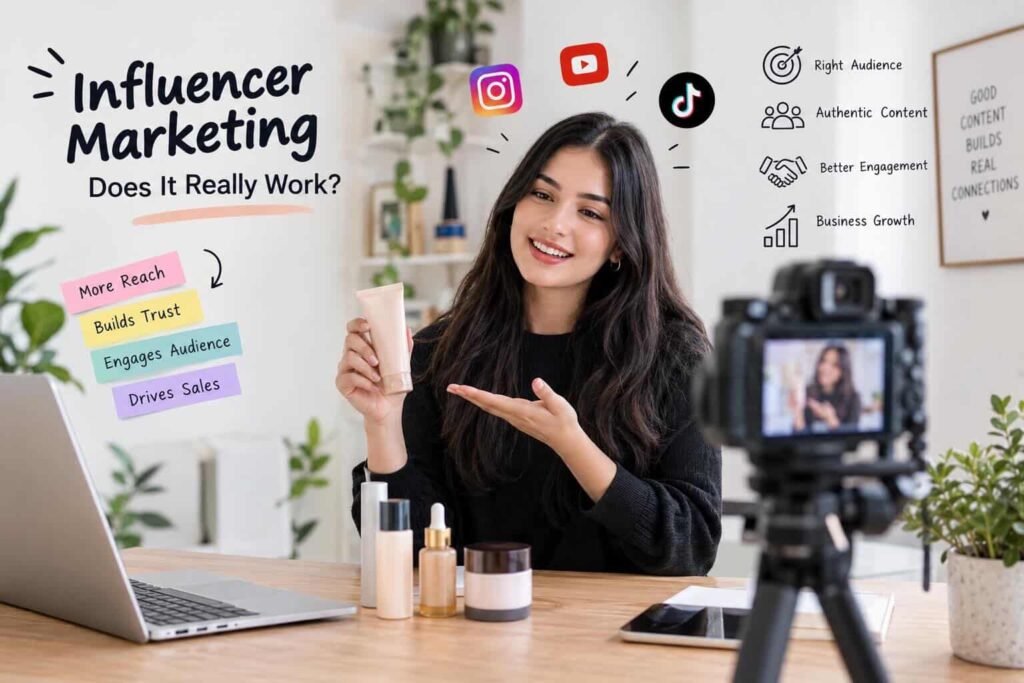
Social media has changed the way people discover products, services, and brands. Today, people do not depend only on traditional advertisements to decide what to buy. They also look at social media posts, reviews, recommendations, videos, and opinions from people they follow online.
This is where influencer marketing has become an important part of digital marketing.
You may have seen influencers promoting skincare products, clothing brands, restaurants, mobile apps, beauty products, fitness programs, or other services. Sometimes an influencer simply recommends a product in a video or post, while in other cases, they create detailed content showing how they use it.
But an important question remains:
Does influencer marketing really work?
The short answer is yes—but its success depends on how it is planned and executed.
Influencer marketing is not simply about paying someone with thousands or millions of followers to promote a product. Successful influencer marketing is about finding the right person, reaching the right audience, creating authentic content, and building trust.
Let’s understand how influencer marketing works and why it has become so popular.
What Is Influencer Marketing?
Influencer marketing is a digital marketing strategy where a brand collaborates with an individual who has an established audience and influence on social media or another online platform.
These individuals are commonly called influencers because their content, opinions, recommendations, or expertise can affect the interests and purchasing decisions of their audience.
For example, a fashion brand may work with a fashion creator to showcase a new collection. A food business may collaborate with a food creator to introduce a new menu. A technology company may work with a tech creator to review a new product.
The influencer creates content around the brand, and the brand gets an opportunity to reach the influencer’s audience.
Why Has Influencer Marketing Become Popular?
One major reason is the growth of social media.
Platforms such as Instagram, YouTube, TikTok, and other social networks have created opportunities for ordinary people to build communities around their interests.
People follow creators because they enjoy their content, opinions, personality, knowledge, or lifestyle.
Over time, followers may develop a sense of familiarity and trust with these creators.
This makes influencer marketing different from traditional advertising.
A traditional advertisement usually comes directly from a company. Influencer marketing can feel more like a recommendation from someone the audience already follows.
How Does Influencer Marketing Work?
Influencer marketing usually involves several steps.
First, a brand identifies its marketing goal. The goal could be increasing brand awareness, promoting a product, generating website traffic, getting leads, or increasing sales.
Next, the brand finds influencers whose audience matches its target customers.
The brand then contacts the influencer and discusses the collaboration.
The influencer may create a post, Reel, Story, video, review, tutorial, or another type of content.
Finally, the brand measures the results to understand whether the campaign was successful.
The important thing is that every step needs to be planned carefully.
Different Types of Influencers
Not every influencer has millions of followers.
Influencers are often divided into different categories based on audience size.
Nano Influencers
Nano influencers usually have a small but highly focused audience.
Their followers may be strongly connected to a specific interest, community, or location.
For small businesses, nano influencers can sometimes be useful because their content can feel personal and relatable.
Micro Influencers
Micro influencers have a larger audience than nano influencers but still maintain a relatively close relationship with their followers.
They often focus on specific niches such as beauty, fashion, fitness, food, travel, technology, or education.
Their niche-focused audiences can make them valuable for targeted campaigns.
Macro Influencers
Macro influencers have a much larger following and can provide significant reach.
Brands may work with them when their primary goal is increasing awareness and reaching a large audience.
Mega Influencers and Celebrities
These influencers have extremely large audiences.
Working with them can provide massive exposure, but such partnerships can also require larger budgets.
For this reason, having a huge following does not automatically mean an influencer is the best choice for every business.
Why Do People Trust Influencers?
One of the biggest strengths of influencer marketing is trust.
People often follow influencers because they feel connected to them.
For example, someone who regularly watches a creator’s skincare videos may trust that creator’s opinions about skincare products.
When that creator introduces a product they genuinely like, followers may be more interested in learning about it.
However, trust can disappear quickly if an influencer promotes too many unrelated products or recommends something that does not match their usual content.
That is why authenticity is extremely important.
Influencer Marketing and Authenticity
Authenticity is one of the most important elements of a successful influencer campaign.
People can often recognize when content feels forced or overly promotional.
For example, imagine a fitness creator suddenly promoting a product that has nothing to do with fitness or their usual content. The promotion may feel unnatural.
On the other hand, if the same creator promotes sportswear, fitness equipment, or a healthy food product, the collaboration may feel more relevant.
The partnership should make sense for both the influencer and the brand.
Does More Followers Mean Better Results?
Not necessarily.
A common mistake businesses make is choosing influencers only because they have a large number of followers.
Follower count is only one factor.
A creator with 20,000 highly engaged followers may sometimes be more useful for a specific campaign than a creator with 500,000 followers whose audience is not interested in the product.
Brands should consider:
- Audience relevance
- Engagement
- Content quality
- Audience demographics
- Niche
- Authenticity
- Previous collaborations
- Campaign goals
The right audience is often more valuable than a large audience.
The Importance of Engagement
Engagement shows how actively an audience interacts with an influencer’s content.
Likes, comments, shares, saves, views, and other interactions can provide useful information about audience interest.
For example, an influencer may have 100,000 followers but receive very little interaction on their posts.
Another influencer may have 15,000 followers and receive strong engagement.
This does not mean engagement alone determines success, but it can help brands understand whether the influencer has an active community.
Benefits of Influencer Marketing
Influencer marketing can offer several benefits to businesses.
- Increased Brand Awareness
Influencers can introduce a brand to people who may not have discovered it otherwise.
When an influencer shares a product, their audience gets an opportunity to learn about the brand.
- Reaching a Targeted Audience
Influencers often focus on specific niches.
A beauty creator can help a beauty brand reach people interested in beauty. A technology creator can help a technology brand reach tech enthusiasts.
This can make influencer marketing more targeted than reaching a completely general audience.
- Building Trust
A recommendation from a trusted creator can make a brand feel more familiar to potential customers.
This can be especially useful for new businesses that are still building their reputation.
- Creating Content
Influencer collaborations can also generate useful content for brands.
A creator may produce photos, videos, reviews, tutorials, or demonstrations that showcase the product.
With permission and appropriate agreements, brands may be able to use this content in their own marketing.
- Increasing Engagement
Influencer content can encourage people to comment, ask questions, share posts, or visit the brand’s profile.
This can help create conversations around a product or service.
- Supporting Sales
Influencer marketing can contribute to sales when the campaign reaches the right audience and provides a clear path to purchase.
Discount codes, affiliate links, product links, and strong calls to action can help businesses track conversions.
Is Influencer Marketing Suitable for Small Businesses?
Yes.
Influencer marketing is not only for large companies.
Small businesses can work with smaller creators who have a strong local or niche audience.
For example, a local restaurant could collaborate with a food creator in the same area.
A small clothing business could work with local fashion creators.
A beauty business could collaborate with a beauty creator whose audience matches its ideal customers.
The key is finding the right creator rather than simply choosing the most popular one.
Common Influencer Marketing Mistakes
Influencer marketing can fail when businesses focus on the wrong things.
Choosing an Influencer Only for Followers
A large follower count does not guarantee good results.
Ignoring Audience Relevance
If the influencer’s audience does not match your target customers, the campaign may generate attention without meaningful results.
Giving the Influencer Too Much or Too Little Control
Brands should provide clear campaign requirements, but influencers also need enough creative freedom to communicate naturally with their audience.
Focusing Only on Likes
Likes are not the only measure of success.
Website visits, leads, sales, saves, shares, and brand awareness can also be important depending on the campaign goal.
Not Measuring Results
If you do not track the campaign, you may not know whether the investment was worthwhile.
How to Choose the Right Influencer
Choosing the right influencer is one of the most important parts of the process.
Start by defining your target audience.
Think about their age, interests, location, needs, and online behavior.
Then look for creators who already speak to that audience.
Check their content and previous collaborations.
Ask yourself:
Does this influencer’s content match my brand?
Would their followers be interested in my product?
Does their communication style feel authentic?
Do they have meaningful engagement?
These questions can help you make a better decision.
Set Clear Campaign Goals
Before starting an influencer campaign, decide what you want to achieve.
Your goal could be:
- Increasing brand awareness
- Launching a new product
- Increasing followers
- Generating website traffic
- Getting leads
- Increasing sales
- Promoting an event
- Creating content
A clear goal makes it easier to choose the right influencer and measure the campaign.
Measure Influencer Marketing Results
After the campaign, analyze the results.
Depending on your goal, you can measure:
- Reach
- Impressions
- Views
- Engagement
- Website traffic
- Clicks
- Leads
- Sales
- Conversions
- Follower growth
For example, if your goal is website traffic, clicks and website visits may be more important than likes.
If your goal is sales, conversions and revenue are more important.
The right metrics depend on the campaign objective.
Influencer Marketing vs Traditional Advertising
Traditional advertising can reach large audiences through television, newspapers, radio, billboards, websites, and other channels.
Influencer marketing works differently.
Instead of communicating directly from the brand to the customer, the message is delivered through a creator.
This can make the communication feel more personal.
However, influencer marketing does not necessarily replace traditional advertising.
Both strategies can be used together as part of a larger marketing plan.
The Future of Influencer Marketing
Influencer marketing continues to evolve.
Short-form videos, live content, niche creators, user-generated content, and community-focused marketing are changing how brands work with creators.
Consumers are also becoming more selective.
They want useful information, honest opinions, relatable stories, and content that feels genuine.
As a result, brands may increasingly focus on long-term relationships with creators rather than one-time promotions.
A creator who genuinely understands and likes a brand can often communicate its message more naturally.
Final Thoughts: Does Influencer Marketing Really Work?
So, does influencer marketing really work?
Yes, influencer marketing can work—but there is no guarantee of success simply because an influencer has a large following.
Successful influencer marketing depends on choosing the right influencer, understanding the target audience, creating authentic content, setting clear goals, and measuring results.
The most important lesson is that influence is not just about numbers. It is about connection and trust.
A smaller creator with the right audience can sometimes create more meaningful results than a celebrity with millions of followers.
For businesses, the goal should not simply be to find the biggest influencer.
The goal should be to find the right influencer for the right audience and the right campaign.
When done thoughtfully, influencer marketing can help brands increase awareness, build trust, create engaging content, reach new audiences, and support business growth.
In a digital world where people are constantly exposed to advertisements, genuine connections can make a big difference.
The future of marketing is not only about reaching more people—it is about reaching the right people in the right way.